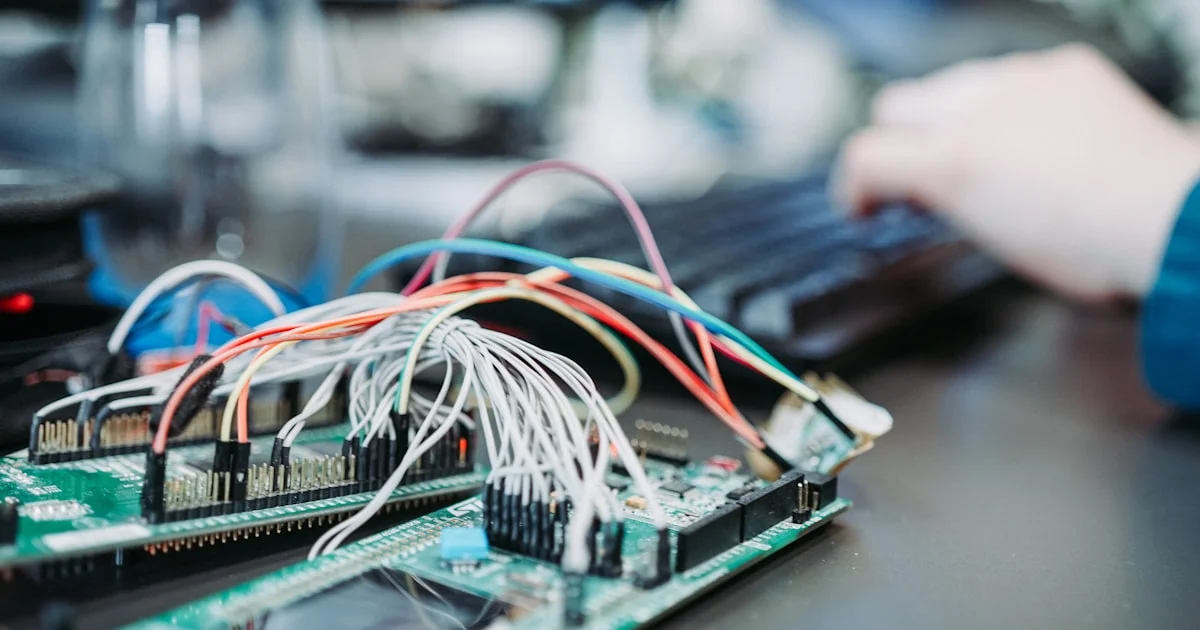
2026 marks a historic turning point in the Internet of Things: The Matter protocol has ended the fragmentation of the smart home world, while Edge AI and TinyML bring intelligence directly to microcontrollers. The combination of unified standards and local AI processing is redefining Industrial IoT and Smart Home.
Matter: The Smart Home Revolution
After years of incompatibility between Zigbee, Z-Wave, Thread, and proprietary solutions, the Matter protocol (formerly Project CHIP) has finally become reality in 2026: A single standard, supported by Apple, Google, Amazon, Samsung, and over 550 other companies.
Matter is built on proven technologies:
- IPv6: Native internet protocol for all devices
- Thread: Mesh network for low latency and high reliability
- Wi-Fi: For bandwidth-intensive applications
- Bluetooth LE: For device setup and commissioning
"Matter is not just a protocol – it's the end of smart home fragmentation. One device, all platforms."
— Connectivity Standards Alliance, 2026
Matter Architecture in Detail
// Matter Device on ESP32 - Smart Plug Example
#include <Matter.h>
#include <MatterOnOffPluginUnit.h>

MatterOnOffPluginUnit plug;

void setup() {
  Matter.begin();

  // Set device attributes
  plug.setProductName("SmartPlug Pro");
  plug.setVendorName("mazdek");
  plug.setSerialNumber("MZDK-2026-001");

  // Callback for on/off commands
  plug.onChangeCallback([](bool state) {
    digitalWrite(RELAY_PIN, state ? HIGH : LOW);
    return true;
  });

  // Start commissioning
  if (!Matter.isDeviceCommissioned()) {
    Matter.beginCommissioning();
  }
}

void loop() {
  // Matter stack handles all communication
  Matter.loop();

  // Sync physical button state
  if (buttonPressed()) {
    plug.toggle();
  }
}
Edge AI & TinyML: Intelligence at the Edge
The shift of AI inference to microcontrollers – known as TinyML – has made enormous progress in 2026. Models with less than 100 KB can perform complex tasks like voice recognition, anomaly detection, and predictive maintenance.
| Platform | RAM | Flash | ML Acceleration | Application |
|---|---|---|---|---|
| ESP32-S3 | 512 KB | 8 MB | Vector Extensions | Wake Word, Vision |
| ESP32-P4 | 768 KB | 16 MB | RISC-V AI Coprocessor | LLM Inference |
| ARM Cortex-M55 | 4 MB | 16 MB | Helium (MVE) | Audio, Sensor Fusion |
| ARM Cortex-M85 | 8 MB | 32 MB | Helium + Ethos-U55 | Complex Vision AI |
TensorFlow Lite Micro Example
// Anomaly detection for predictive maintenance
#include <TensorFlowLite_ESP32.h>
#include "anomaly_model.h"

// Model and interpreter
const tflite::Model* model;
tflite::MicroInterpreter* interpreter;
constexpr int kTensorArenaSize = 32 * 1024;
uint8_t tensor_arena[kTensorArenaSize];

void setup() {
  // Load model (quantized to INT8)
  model = tflite::GetModel(anomaly_model_tflite);

  // Configure interpreter
  static tflite::MicroMutableOpResolver<5> resolver;
  resolver.AddFullyConnected();
  resolver.AddRelu();
  resolver.AddSoftmax();

  static tflite::MicroInterpreter static_interpreter(
    model, resolver, tensor_arena, kTensorArenaSize
  );
  interpreter = &static_interpreter;
  interpreter->AllocateTensors();
}

float detectAnomaly(float* sensorData, int dataLength) {
  // Fill input tensor
  TfLiteTensor* input = interpreter->input(0);
  for (int i = 0; i < dataLength; i++) {
    input->data.f[i] = sensorData[i];
  }

  // Run inference (~5ms on ESP32-S3)
  interpreter->Invoke();

  // Read anomaly score
  TfLiteTensor* output = interpreter->output(0);
  return output->data.f[0];
}
Industrial IoT: Measurable Benefits
The integration of Edge AI in industrial environments delivers impressive results. Based on projects from 2025/2026, the following average values are observed:
| KPI | Before | With Edge AI | Improvement |
|---|---|---|---|
| Unplanned Downtime | 12% | 8.4% | -30% |
| Production Output | Baseline | +25% | +25% |
| Energy Consumption | Baseline | -18% | -18% |
| Maintenance Costs | Baseline | -22% | -22% |
| Cloud Data Transfer | 100% | 15% | -85% |
Predictive Maintenance in Practice
A typical setup for predictive maintenance includes:
- Vibration Sensors: ADXL345 or LIS3DH on each critical asset
- Edge Controller: ESP32-S3 with TinyML model per machine group
- LoRaWAN Gateway: For comprehensive connectivity without Wi-Fi infrastructure
- Dashboard: Real-time visualization with Grafana and InfluxDB
// LoRaWAN Sensor Node for Vibration Measurement
#include <Arduino.h>
#include <LoRaWan-Arduino.h>
#include <SPI.h>
#include "vibration_model.h"

// LoRaWAN Configuration (OTAA)
uint8_t nodeDeviceEUI[8] = { /* ... */ };
uint8_t nodeAppEUI[8] = { /* ... */ };
uint8_t nodeAppKey[16] = { /* ... */ };

struct SensorPayload {
  uint8_t anomalyScore;  // 0-255 (normalized)
  int16_t peakVibration; // mm/s * 100
  int16_t rmsVibration;  // mm/s * 100
  uint16_t temperature;  // C * 100
  uint8_t batteryLevel;  // Percent
} __attribute__((packed));

void sendVibrationData() {
  SensorPayload payload;

  // Capture and analyze vibration data
  float rawData[256];
  readAccelerometer(rawData, 256);

  // Edge AI Inference
  payload.anomalyScore = (uint8_t)(detectAnomaly(rawData) * 255);
  payload.peakVibration = (int16_t)(calculatePeak(rawData) * 100);
  payload.rmsVibration = (int16_t)(calculateRMS(rawData) * 100);
  payload.temperature = (int16_t)(readTemperature() * 100);
  payload.batteryLevel = getBatteryPercentage();

  // Only send on anomaly or every 15 minutes
  if (payload.anomalyScore > 180 || isScheduledTransmission()) {
    lmh_send(&payload, sizeof(payload), LMH_UNCONFIRMED_MSG);
  }
}
Unified Embedded-IoT Platforms
In 2026, embedded development and IoT platforms are merging into unified ecosystems. The key trends:
1. ESP-IDF 6.0 + Matter + TinyML
Espressif has created a fully integrated platform with ESP-IDF 6.0:
- Native Matter Support: Certified implementation out of the box
- ESP-DL 2.0: Optimized ML inference with quantized models
- ESP-Rainmaker: Cloud integration with privacy-first approach
- ESP-NOW 2.0: Proprietary mesh for ultra-low latency
2. Zephyr RTOS
The Linux Foundation project Zephyr has established itself as the leading RTOS for IoT:
// Zephyr + Matter + Sensors
#include <zephyr/kernel.h>
#include <zephyr/drivers/sensor.h>
#include <matter/matter.h>

// Thread-safe sensor query
K_MUTEX_DEFINE(sensor_mutex);

void sensor_thread(void *arg1, void *arg2, void *arg3) {
  const struct device *accel = DEVICE_DT_GET(DT_ALIAS(accel0));
  struct sensor_value val[3];

  while (1) {
    k_mutex_lock(&sensor_mutex, K_FOREVER);

    sensor_sample_fetch(accel);
    sensor_channel_get(accel, SENSOR_CHAN_ACCEL_XYZ, val);

    // Forward data to Matter cluster
    update_matter_sensor_cluster(val);

    k_mutex_unlock(&sensor_mutex);
    k_sleep(K_MSEC(100));
  }
}

K_THREAD_DEFINE(sensor_tid, 1024, sensor_thread,
                NULL, NULL, NULL, 7, 0, 0);
3. PlatformIO + Edge Impulse
The combination of PlatformIO and Edge Impulse enables an end-to-end ML pipeline:
# platformio.ini - Production Setup
[env:esp32s3]
platform = [email protected]
board = esp32-s3-devkitc-1
framework = espidf

lib_deps =
  espressif/esp-matter@^1.2.0
  edgeimpulse/ei-esp32-library@^1.5.0

build_flags =
  -DCONFIG_ESP_MATTER_ENABLE_DATA_MODEL=1
  -DCONFIG_TFLITE_MICRO_QUANTIZATION=INT8
  -DCONFIG_SPIRAM_USE_MALLOC=1

; Enable OTA updates
upload_protocol = espota
upload_port = 192.168.1.100
Post-Quantum Cryptography for IoT
With the advancement of quantum computers, post-quantum cryptography (PQC) is becoming essential for IoT. In 2026, migration to quantum-safe algorithms begins:
CRYSTALS-Kyber for Key Exchange
The NIST-standardized algorithm CRYSTALS-Kyber replaces classical ECDH:
// Post-Quantum Key Exchange on ESP32
#include <pqcrypto_kyber.h>

// Kyber-768 (NIST Level 3 Security)
uint8_t publicKey[KYBER768_PUBLICKEYBYTES];
uint8_t secretKey[KYBER768_SECRETKEYBYTES];
uint8_t ciphertext[KYBER768_CIPHERTEXTBYTES];
uint8_t sharedSecret[KYBER768_SSBYTES];

void generateKeyPair() {
  // Generate key pair (~15ms on ESP32-S3)
  crypto_kem_keypair(publicKey, secretKey);
}

void encapsulate(uint8_t* peerPublicKey, uint8_t* outCiphertext,
                 uint8_t* outSharedSecret) {
  // Create shared secret (~20ms)
  crypto_kem_enc(outCiphertext, outSharedSecret, peerPublicKey);
}

void decapsulate(uint8_t* ciphertext, uint8_t* outSharedSecret) {
  // Recover shared secret (~25ms)
  crypto_kem_dec(outSharedSecret, ciphertext, secretKey);
}
Hybrid Security
For maximum security, modern IoT systems combine classical and post-quantum-safe algorithms:
- TLS 1.3 + Kyber: Hybrid handshakes with X25519 and Kyber-768
- CRYSTALS-Dilithium: Post-quantum-safe signatures for firmware updates
- SPHINCS+: Hash-based signatures as backup
LoRaWAN: Long-Range for Industrial IoT
LoRaWAN remains the leading LPWAN technology for Industrial IoT in 2026, with important updates:
LoRaWAN 1.1 + Relay Function
// LoRaWAN Relay Node for Extended Range
#include <LoRaWAN_Relay.h>

// Relay Configuration
RelayConfig config = {
  .mode = RELAY_MODE_DYNAMIC,
  .maxHops = 2,
  .forwardingDelay = 50,  // ms
  .dutyCycleLimit = 1.0,  // 1%
};

void setup() {
  LoRaWAN.begin(EU868);
  LoRaWAN.enableRelay(config);

  // Automatic relay discovery
  LoRaWAN.setRelayDiscovery(true);
}

void loop() {
  // Relay automatically handles forwarding
  LoRaWAN.process();

  // Send own sensor data
  if (shouldTransmit()) {
    sendSensorData();
  }
}
Spreading Factor Optimization
| SF | Range | Data Rate | Airtime (11 Bytes) | Application |
|---|---|---|---|---|
| SF7 | 2 km | 5.5 kbps | 46 ms | Frequent Updates |
| SF9 | 6 km | 1.7 kbps | 165 ms | Balanced |
| SF12 | 15+ km | 0.3 kbps | 1483 ms | Maximum Range |
The ESP32 Ecosystem 2026
Espressif's ESP32 family continues to dominate the IoT market with specialized variants:
ESP32-P4: The New AI Champion
- CPU: Dual-Core RISC-V @ 400 MHz
- AI Accelerator: Dedicated tensor processor for INT8/INT4
- RAM: 768 KB internal + 32 MB PSRAM
- Interfaces: MIPI-CSI, MIPI-DSI, USB OTG, Ethernet
- Performance: 10x faster ML inference vs. ESP32-S3
ESP32-C6: Matter-Ready
- Wi-Fi 6: 802.11ax for better battery life
- Thread 1.3: Native Matter Border Router capability
- Zigbee 3.0: For legacy device integration
- BLE 5.3: Long Range and higher data rates
// ESP32-C6 as Matter Border Router
#include <esp_matter.h>
#include <esp_openthread.h>
#include <esp_wifi.h>

void app_main() {
  // Initialize Wi-Fi
  ESP_ERROR_CHECK(esp_wifi_init(&wifi_init_config));
  ESP_ERROR_CHECK(esp_wifi_start());

  // Initialize OpenThread (Thread)
  esp_openthread_platform_config_t ot_config = {
    .radio_config = ESP_OPENTHREAD_RADIO_CONFIG_DEFAULT(),
    .host_config = ESP_OPENTHREAD_HOST_CONFIG_DEFAULT(),
  };
  ESP_ERROR_CHECK(esp_openthread_init(&ot_config));

  // Start Matter stack with Border Router
  esp_matter_config_t matter_config = {
    .bridge_mode = true,
    .thread_border_router = true,
  };
  ESP_ERROR_CHECK(esp_matter_init(&matter_config));

  // Enable Matter commissioning
  esp_matter_start();
}
Best Practices for IoT Projects 2026
1. Security by Design
Implement security from the start:
- Hardware Security Module (HSM) for key storage
- Enable secure boot and flash encryption
- OTA updates with code signing
- Regular security audits
2. Edge-First Architecture
Process data locally wherever possible:
- ML inference on the device
- Only send relevant events to the cloud
- Offline capability as a requirement
3. Interoperability Through Standards
Rely on open standards:
- Matter for Smart Home
- LoRaWAN for Long-Range
- OPC UA for Industry 4.0
- MQTT/CoAP for messaging
4. Energy Efficiency
Optimize power consumption:
- Deep sleep with periodic wake-up
- Adaptive Spreading Factor for LoRa
- Event-based instead of periodic transmission
Conclusion: IoT Has Come of Age
2026 marks the transition of IoT from fragmented prototypes to mature, interoperable systems. The key factors:
- Matter has ended smart home fragmentation
- Edge AI enables intelligent decisions without cloud latency
- Post-Quantum Cryptography prepares for the future
- Unified Platforms massively simplify development
At mazdek, we develop future-proof IoT solutions that optimally leverage these technologies – from smart home integrations to industrial IoT systems with predictive maintenance.